
This week, we wrap up Cooperative Enterprise and Market Economy by Chilean social theorist Luis Razeto Migliaro, and translated by GEO's own Matt Noyes. In the final chapter Razeto makes some general observations about relationships between individual freedom, the state, and cooperativism.
Then, Steve Herrick writes about GEO's return to print publication, and why we would be doing such a thing in 2026.
And there's still time to grab a ticket for our upcoming Poetry Slam fundraising event on May 4th. Prices are on a sliding scale to fit every budget, so don't hesitate to pick one up and join us for an evening of poetry and solidarity.
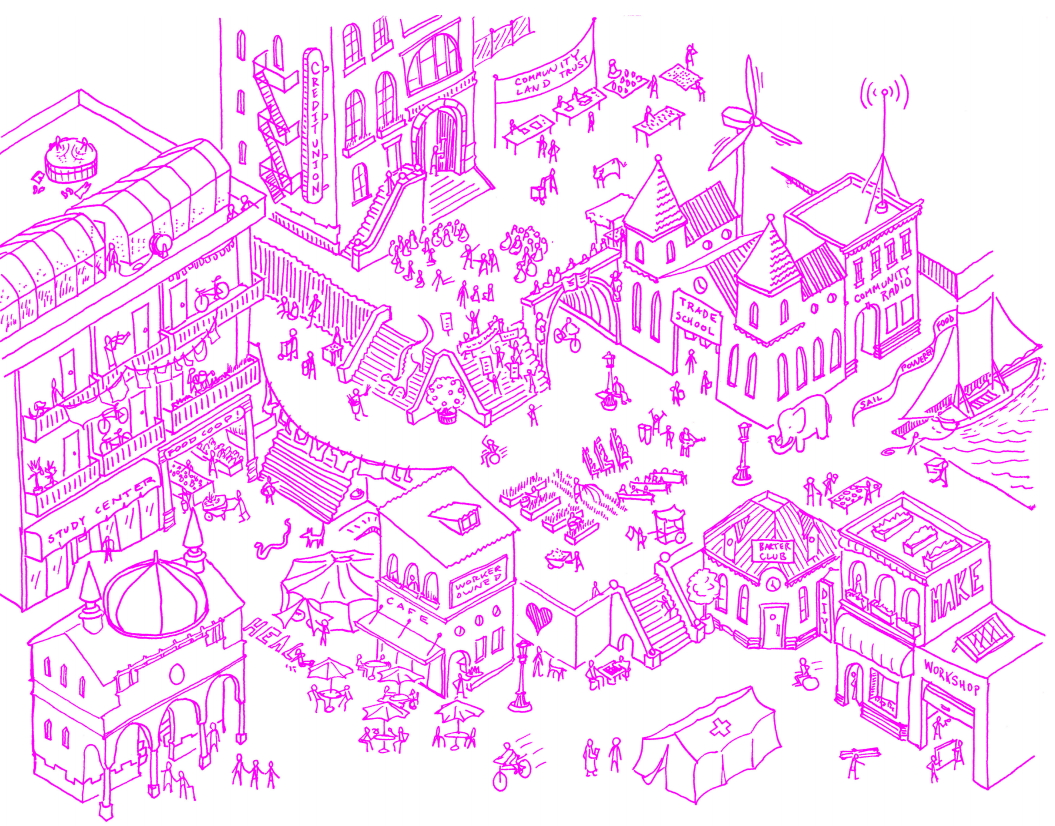
Cooperative Enterprise and Market Economy: Chapter 20
by Luis Razeto Migliaro, transl. by Matt Noyes
Cooperative economic organization creates, then, free individuals with a sense of social bonds and solidarity and provides opportunities for their growth. The bourgeois economic schema, in contrast, has a limited capacity for assimilation of free individuals, and, once saturated, expels more individuals than it integrates.
GEO Returns to Print!
by Steve Herrick
We’ll continue publishing online, of course, but we’ve missed creating something tangible. A paper journal is a healthy alternative to doomscrolling. There’s no comment section, but maybe you’ll comment on it to a friend over coffee. There’s no Like button, but we hope you like it and find it informative.
Nominations now open for the Cooperative Cultural Heritage List
International Cooperative Alliance — Launched in 2025 at the Itamaraty Palace in Brasilia, as part of the UN International Year of Cooperatives, the CCH programme celebrates places and traditions that embody the legacy, idea and practice of cooperation worldwide. The 2025 launch highlighted an inaugural list of tangible elements or sites connected to the birth and development of cooperative movements, institutions and practices that have shaped societies around the world...In 2026, the goal is to include around 35 additional sites from 25 countries – nominated by members and verified by the working group – amplifying the geographic and cultural representation of the cooperative movement. In addition to physical sites, ICA will also explore the inclusion of intangible cultural elements that reflect cooperative ideas, practices and traditions...
Solidarity Economies for Collective Power, with Jason Nardi
Local Futures (YouTube) — Jason Nardi is the European coordinator of RIPESS - the Intercontinental Network for the Promotion of Social Solidarity Economy, president of RIES (Italian Solidarity Economy Network) and co-founder of Solidarius Italia. Jason is an active member of the International Council of the World Social Forum and promoter of the World Social Forum on Transformative Economies.
CDI is Hiring an Executive Director
Cooperative Development Institute — Cooperative Development Institute is a regional 501(c)(3) non-profit founded in 1994 by co-op leaders in the Northeast. CDI’s mission is to create and sustain democratically owned cooperative enterprises and networks in the Northeast that grow a prosperous, equitable economy. We envision a world where every person can fulfill their needs and aspirations...
The True Origins of Mutual Aid and the Danger of Getting It Wrong
Zedé — My starting premise is simple: a community welfare system is not just moments of aid. It requires structure. I organize that structure around four pillars: a mutual aid resource pool, operational programs, shared leadership and long-term stewardship, and strong volunteer coordination. The goal is to make support consistent and reliable rather than episodic and heroic...
Like what you find on GEO?
Make a Donation Today!
Your tax-deductible contribution ensures that GEO can continue to provide independent grassroots content about the cooperative and solidarity economy movements.
Got something to say?
Let us know. Send your comments, suggestions, rants and article submissions to editors@geo.coop.
Follow us on Social Media
Mastodon: social.coop/@GEO_Collective
BlueSky: @geocollective.bsky.social
FB: facebook.com/GEOCollective
Instagram: instagram.com/grassrootsecon
Our mailing address is:
Grassroots Economic Organizing
P.O. Box 115
Riverdale MD 20738-0115
