
This week, Dylan Hatch shares the results of his research into union co-ops - worker co-ops with union representation - in the US, focusing on three in particular: Co-op Rhody, WorX Printing, and Gimme Coffee. Dylan highlights the differences in how each co-op came to be involved with a union, and differences between "union co-ops" and "unionized co-ops."
Then, Marc Sweeney of the UK's Equal Care Co-op writes about a new academic paper that lauds organizations like Equal Care as 'laboratories of social innovation' - places where people "experiment with possible futures" and develop approaches that can be adapted by other communities.
And finally, we're trying to find out about the extent and manner of worker co-ops' use of "AI" tools. To that end, we have made a short survey that we're encouraging worker co-ops to take a moment and fill in. If you're a member of a worker co-op, please take a few minutes to let us know how you're approaching things.
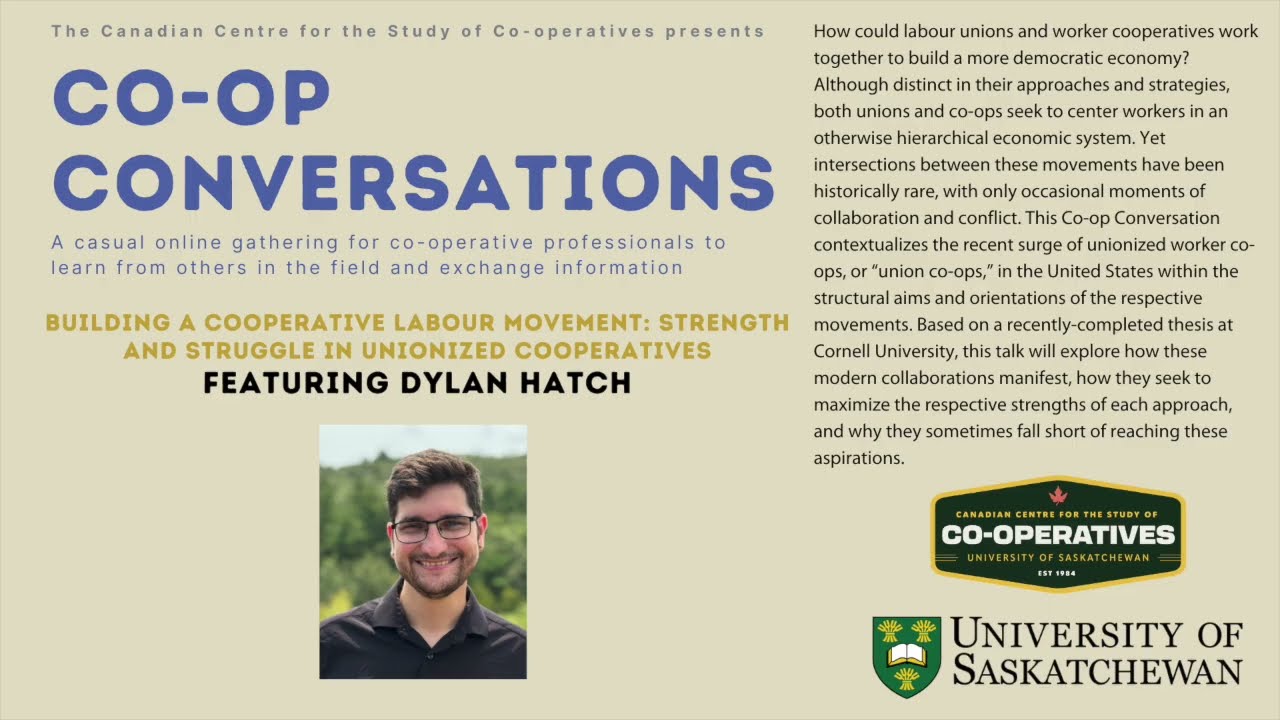
Building a Cooperative Labour Movement
by Canadian Centre for the Study of Co-operatives
How could labour unions and worker cooperatives work together to build a more democratic economy? Although distinct in their approaches and strategies, both unions and co-ops seek to center workers in an otherwise hierarchical economic system. Yet intersections between these movements have been historically rare, with only occasional moments of collaboration and conflict.

Laboratories of Social Innovation
by Marc Sweeney
We've written before about how mainstream care provision increasingly resembles a 'Deliveroo model': workers allocated tasks based on availability, relationships sacrificed for efficiency, care reduced to bullet points on a rota. A compensatory approach might try to make that system slightly less dehumanising (perhaps adding a smiley face to an automated instruction?). A transformative approach essentially asks: what if we stopped treating workers like tools, and stopped reducing people to their care needs?

ICA unveils theme for CoopsDay 2026: Cooperatives for a Peaceful World
The Cooperator — The International Cooperative Alliance [ICA] has unveiled “Cooperatives for a Peaceful World” as the theme for the 2026 International Day of Cooperatives [CoopsDay], underscoring the sector’s role in fostering unity and stability. The ICA said the theme reflects the cooperative model’s capacity to bring people together, strengthen social cohesion and advance inclusive, peaceful societies. It also serves as a call to action for cooperatives worldwide to play a more active role in peacebuilding...
Kenyan tea and coffee co-operatives tackle child labour
Co-op News — Kenyan co-operatives have joined a national push to address child labour in the tea and coffee value chain, as part of a wider effort by the country’s government and development agencies to eradicate the practice...Now in its second phase, Accel says it is adopting a systems-based approach to the root causes of child labour, such as poverty, low income, informality, and limited institutional capacity within agricultural value chains across the region...
The Case for Indivisible Reserves in Worker Co-ops
Canadian Worker Co-operative Federation (YouTube) — Cooperative developer and worker-owner Marty Frost makes the case for indivisible reserves in worker co-ops.

Like what you find on GEO?
Make a Donation Today!
Your tax-deductible contribution ensures that GEO can continue to provide independent grassroots content about the cooperative and solidarity economy movements.
Got something to say?
Let us know. Send your comments, suggestions, rants and article submissions to editors@geo.coop.
Follow us on Social Media
Mastodon: social.coop/@GEO_Collective
BlueSky: @geocollective.bsky.social
FB: facebook.com/GEOCollective
Instagram: instagram.com/grassrootsecon
Our mailing address is:
Grassroots Economic Organizing
P.O. Box 115
Riverdale MD 20738-0115
