
This week, retired USDA Economist Bruce Reynolds writes about two of the main tactics that investor owned firms have historically employed to compete against cooperatives offering superior products and services: lobbying for policies unfavorable to co-ops, and undermining solidarity by targeting co-op members with selective pricing. Reynolds traces these practices from mid-19th century ag cooperatives up to the present day, and warns that non-agricultural co-ops should expect to face similar efforts whenever they gain significant market share.
Then, Penn Loh recounts the last fifteen years of solidarity economy organizing in Massachusetts, and shares some stories and lessons from the numerous projects that he has been a part of.
And if you are a member of a worker co-op, please take a few minutes to complete this anonymous survey about if and how your cooperative is us "AI" tools.
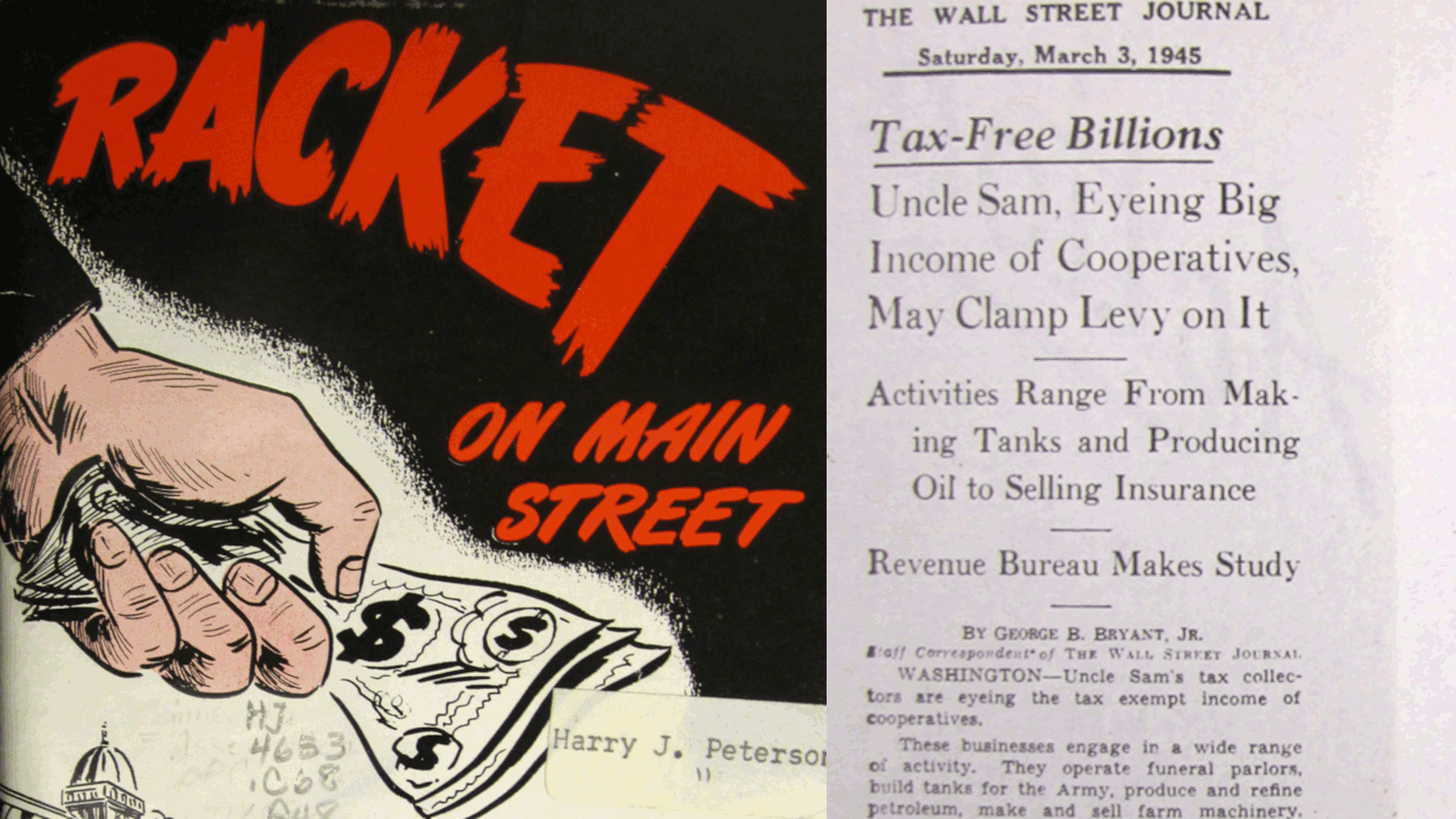
How Investor Owned Firms Compete With Cooperatives
by Bruce J. Reynolds
In addition to the policy arena, IOFs [investor owned firms] have also used various marketing strategies in attempts to weaken solidarity and divide cooperative members. These tactics for weakening solidarity have persisted from the early period of farmer cooperatives to the present day. Two case studies demonstrate these strategies that were examined during recent decades by USDA/Cooperative Service.
Solidarity Economy Movements in Massachusetts
by Cities@Tufts
Loh traced how these movements, many of which he has been involved with, have been fighting for and building over the past fifteen years, [finding] various ways of living in interdependence and collective care, around projects such as worker-owned cooperatives, community land trusts, community investment funds, mutual aid, and more.


Quebec co-op members rally against Bill 20
The Montreal Gazette — Introduced in February by then housing minister Caroline Proulx, Bill 20 would overhaul the income thresholds generally used to determine who can enter affordable housing and co-operatives. Now, residents are not forced out if their financial situation later improves. But Bill 20 would change that, introducing financial penalties for some residents whose income rises above thresholds that have not yet been determined...
How LaSuite.coop Is Building a New Model for Digital Sovereignty
Free Knowledge Institute — LaSuite.coop is a multi-stakeholder cooperative being established in France by a consortium of long-standing cooperative actors in the digital space...The service is already operational (join as member and/or access their demo)....LaSuite.coop offers organisations a complete collaborative workspace built on the tools developed and integrated by DINUM...
REI Union workers launch boycott over dispute with co-op
Co-op News — The union claims that REI “failed to offer a single proposal until the final day of bargaining, and failed to send its own vice president of labor relations, or any key decision-maker, to the table”. Campaigners hit out at “outlandish, bad faith proposals” from the co-op, including a moratorium on the REI Union’s organising activity, which would prevent it from supporting workers at other REI stores hoping to unionise for the duration of the contract...
#CoopsDay highlights cooperatives as bridge builders
NCBA CLUSA — The theme also highlights the role of cooperatives as bridge-builders, bringing communities together, fostering dialogue and democratic decision-making, and strengthening stability and resilience in an increasingly fragmented world. At a time when many people are navigating conflict, deepening political divides, economic instability and growing distrust and loneliness, cooperatives can build bridges that rebuild trust and strengthen social cohesion...
Argentina’s co-operativas escolares: A case study in co-op education
Co-op News — The country’s cooperativas escolares (school co-operatives) have a long history, which can be traced to 1946 legislation that formally established the teaching of co-operativism and the creation of school co-operatives. Rather than being a fringe or extracurricular activity, these initiatives are recognised as a pedagogical tool integrated into the curriculum across subjects. The explicit goal is not profit or practical skills, but the development of citizens, democratic participation, and an education based on values. Students genuinely run these co-operatives, which can range from food production and recycling to technology, media, and community commerce. They elect boards, manage finances and hold assemblies, with teachers acting as advisors...
All Hands On Deck! Everyone Has a Role to Play in the Movement
Sustainable Economies Law Center — Help us raise $40,000 this month to support this important work. 10% of your support will go directly to our Solidarity Partner, Huitlaco Mushrooms – a worker-owned, agroecological mushroom and compost farm in North Richmond, CA that produces food, medicine, and soil amendments for community resilience. Huitlaco Mushrooms is an inspiring example of land stewards creating sustainable food systems, while also building people power through collective ownership...

Like what you find on GEO?
Make a Donation Today!
Your tax-deductible contribution ensures that GEO can continue to provide independent grassroots content about the cooperative and solidarity economy movements.
Got something to say?
Let us know. Send your comments, suggestions, rants and article submissions to editors@geo.coop.
Follow us on Social Media
Mastodon: social.coop/@GEO_Collective
BlueSky: @geocollective.bsky.social
FB: facebook.com/GEOCollective
Instagram: instagram.com/grassrootsecon
Our mailing address is:
Grassroots Economic Organizing
P.O. Box 115
Riverdale MD 20738-0115
